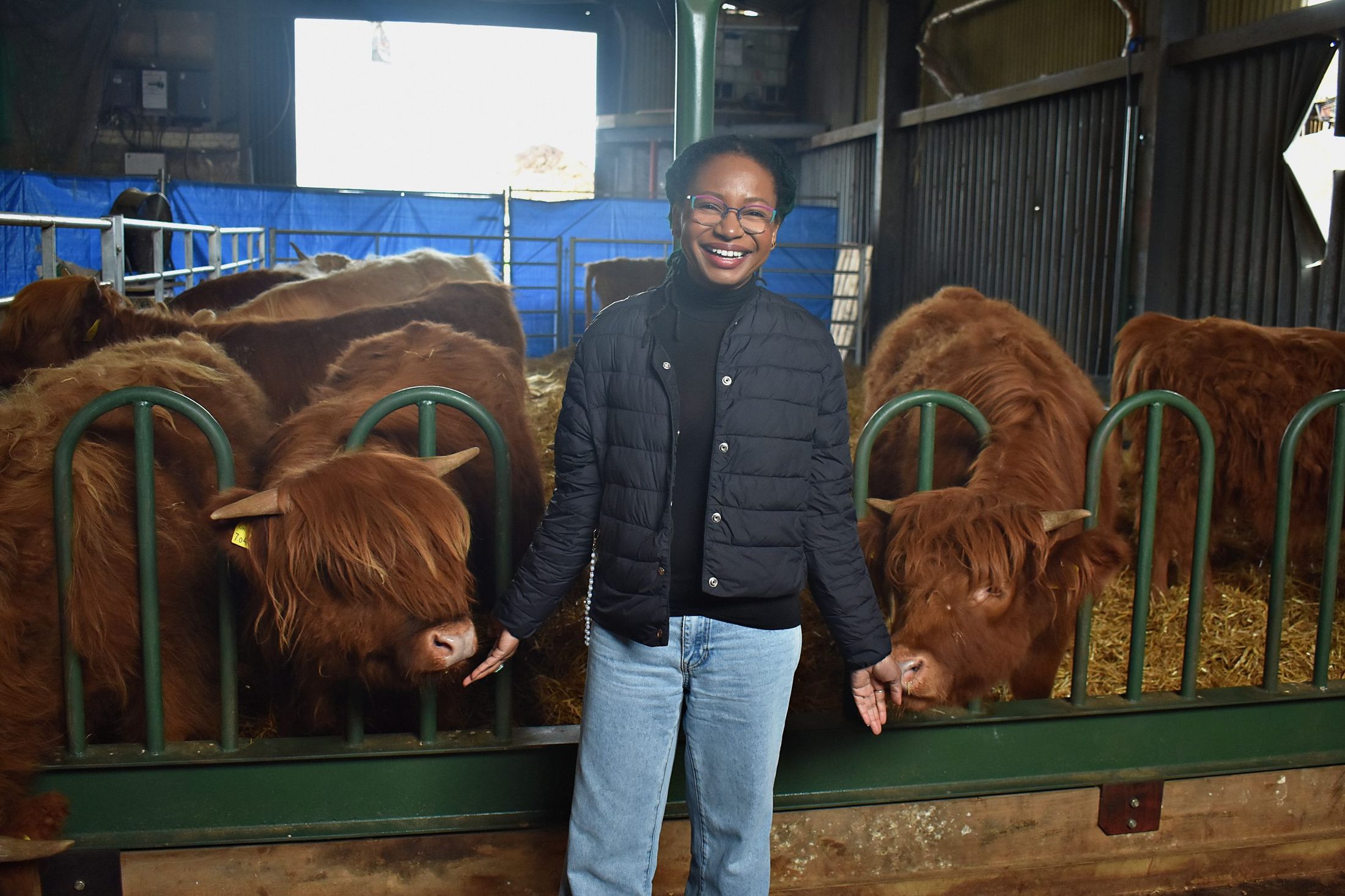
Genell Zuciya standing between two ginger Highland cattle in a barn, one hand resting toward each, smiling.
Filmmaker · Documentarian · Citizen Scientist

Genell
Zuciya

Filmmaker · Documentarian · Citizen Scientist
People and the living world, one spectrum
Sequenced by colour ↓
In the field · Pacific Northwest

Fomes fomentarius, the hoof fungus Ötzi the Iceman carried to start fires — the size of a dinner plate, and the only reasonable response is to hand it to someone else and marvel.

Scarlet#E8402E
Red-crested cardinalParoaria coronata The same red, an ocean away and made of feathers instead of shell. Native to South America, introduced in the 1930s, entirely at home now. Introduced c. 1930s · Oʻahu, Hawaiʻi
Gooseneck barnaclesPollicipes sp. They live where every wave would tear most animals off the rock. They hold on with a protein cement materials scientists still cannot reproduce, and feed by reaching into the water that is trying to kill them. Surf zone · Pacific coast
Split fish, red menu A wet market threaded into a restaurant front — dried fish overhead, live tanks at the curb, the whole day's specials in red and gold on the wall. Everything for sale is either still moving or drying in the open air. Wet market · Shanghai
The plant that eatsSarracenia purpurea Newfoundland’s provincial flower, and a carnivore. It grows in bogs so nutrient-poor that it gave up on soil and started eating animals instead — rain fills its pitcher, insects drown, enzymes do the rest. The maroon veining is a lure, drawing prey down into the trap. Carnivorous · bog specialist · Newfoundland
Amber, Ochre & Ginger#FF7A33
Golden silk orb-weaverNephila sp. Her dragline silk is, by weight, tougher than Kevlar — the second material in this section we cannot yet manufacture, after the barnacle’s cement. The web can span a forest path; the gold is real, and it is structural. Silk stronger than steel by weight · Costa Rica
Desert globemallowSphaeralcea sp. A pioneer species — it takes the disturbed, mineral-poor ground nothing else wants, blooming on the eroded remains of a Late Triassic floodplain. Chinle Fm. · ~220 Ma · Petrified Forest NP, AZ
The tailor A tape measure round his neck, a hand-cranked machine, and an armful of wax-print cloth — the whole shop the colour of the wall behind it. West African wax print carries its own language: patterns have names, and a well-chosen cloth says something the wearer means. Wax-print tailor · Guinea, West Africa
Common mynaAcridotheres tristis Brought here in 1865 to eat armyworms in the cane fields — a biological control that worked, and then kept going. Now one of the most successful birds on earth, and sitting on our wire, watching. Introduced 1865 · Oʻahu, Hawaiʻi
Highland cowBos taurus taurus The same ginger, half a planet away, doing a different job. The fringe is a double coat — an oily outer layer that sheds the rain, a downy one beneath that holds the heat. Everything about the animal is an answer to Scottish weather. Native breed · Jedburgh, Scottish Borders
Criollo cattle, high countryBos taurus The third working cattle on this page — after the Hawaiian paniolo herds and the Scottish Highlands. These are criollo, descended from the first cattle the Spanish brought to the Americas, now bred five centuries into the thin air of the high Andes. Criollo · high-altitude · Peru
Green#8FBF3C
A trick of the lightTrochilidae This green is not pigment. It is structural colour — microscopic layers in the feather that interfere with light, the same physics as a soap bubble or an oil slick. Turn the bird and the colour moves. The feather is not coloured; it is engineered. Cloud forest · Costa Rica
The one with the swordEnsifera ensifera The only bird on earth whose bill is longer than its body. It co-evolved with a single long tubular passionflower no other pollinator can reach — a private key to a private lock. At rest it must hold the bill pointed almost straight up, just to balance the weight of its own tool. Longest bill-to-body ratio of any bird · [TK: Peru?]
Bone#F4F0EA
The reason the egrets cameBos taurus Cattle reached these islands in 1793, a gift to Kamehameha I. A royal kapu protected them, so they multiplied into feral herds — and Mexican vaqueros were brought in to manage them. The paniolo were working cattle in Hawaiʻi before the American cowboy existed. Introduced 1793 · paniolo country · Oʻahu, Hawaiʻi
Cattle egretBubulcus ibis Released in 1959 to eat the flies off the cattle above — the same bargain the islands made with the myna a century earlier. It follows livestock for a living: hooves stir the grass, insects jump, the egret is already there. Introduced 1959 · pest control · Oʻahu, Hawaiʻi
Land hermit crabCoenobita sp. It grew no shell of its own — it wears another animal’s, and trades up as it grows. On a Costa Rican coast the crabs line up by size to swap shells in sequence, the neatest recycling economy on the beach. Borrowed shell · vacancy chain · Costa Rica
Slate#8A97A6
Hiding in plain sightAnolis sp. An anole colour-matched to weathered wood so precisely it nearly disappears. Anoles can shift shade with temperature and mood, and males flash a bright throat-fan to signal — a creature that is either invisible or unmissable, depending on what it needs to be. Camouflage · [TK: location]
The seamstress and the laugh Two generations of a lane, a few feet apart — one at the sewing machine in the dark of the shop, one in the sun outside, caught mid-laugh. The work and the rest, in one frame. Old town lane · Xinchang
Sow Coiffure The prices are painted straight onto the mirror frame — barbe 1500, coiffure 2500. An open-air shop, a single pair of clippers, and a steady line of men waiting their turn in the shade. Street barbershop · Guinea, West Africa
Blue#5B93DB
Deep time, folded The grey rock in the foreground was once flat layers of seabed, bent into these swirls by the slow collision of continents. What looks like frozen liquid is stone that flowed — given enough pressure and enough time, rock behaves like taffy. Deformed strata · tectonic folding · Newfoundland
Rounded by the sea Pale boulders worn smooth on a Newfoundland shore, a fishing village strung along the far side of the water. The sea rounds everything it touches, slowly. Wave-rounded · Newfoundland
The village across the water A clear northern day on the Gulf of St. Lawrence — rock, water, sky, and a line of houses that have weathered a great many of these summers and the winters between them. Coastal outport · Newfoundland
Where the cliff comes down A folded cliff meets a beach of red-brown cobbles it has been shedding for millennia. The rock above is the source; the stones below are its future, one storm at a time. Cobble beach · eroding cliff · Newfoundland
Purple & Magenta#C94FD8
First after fireChamerion angustifolium Fireweed — named for how it rushes into burned ground, the first colour back after a fire or a clear-cut. Behind it stand the Tablelands of Gros Morne: flat-topped mountains of the Earth’s mantle, rock from deep beneath the crust, shoved to the surface half a billion years ago. Fire-follower · Tablelands mantle rock · Gros Morne, Newfoundland
FoxgloveDigitalis purpurea The spotted throats are runway lights — nectar guides that steer a bumblebee to the back of the bell, where it must brush the anthers to get paid. The plant is also lethal, and it is heart medicine: digitalis slows and strengthens a failing heartbeat. Poison and cure, separated only by dose. Cardiac glycosides · bee-pollinated · on the road to Loch Ness

Nova Scotia & Newfoundland

In process